Last updated 4mo ago
Log in to add personal notes on this page.
A newborn has multiple fractures noted at birth, including healing rib fractures suggesting prenatal injury. The baby has blue sclerae. Family history reveals the father has had multiple fractures and hearing loss.
Most AD; COL1A1 or COL1A2 (type I collagen)
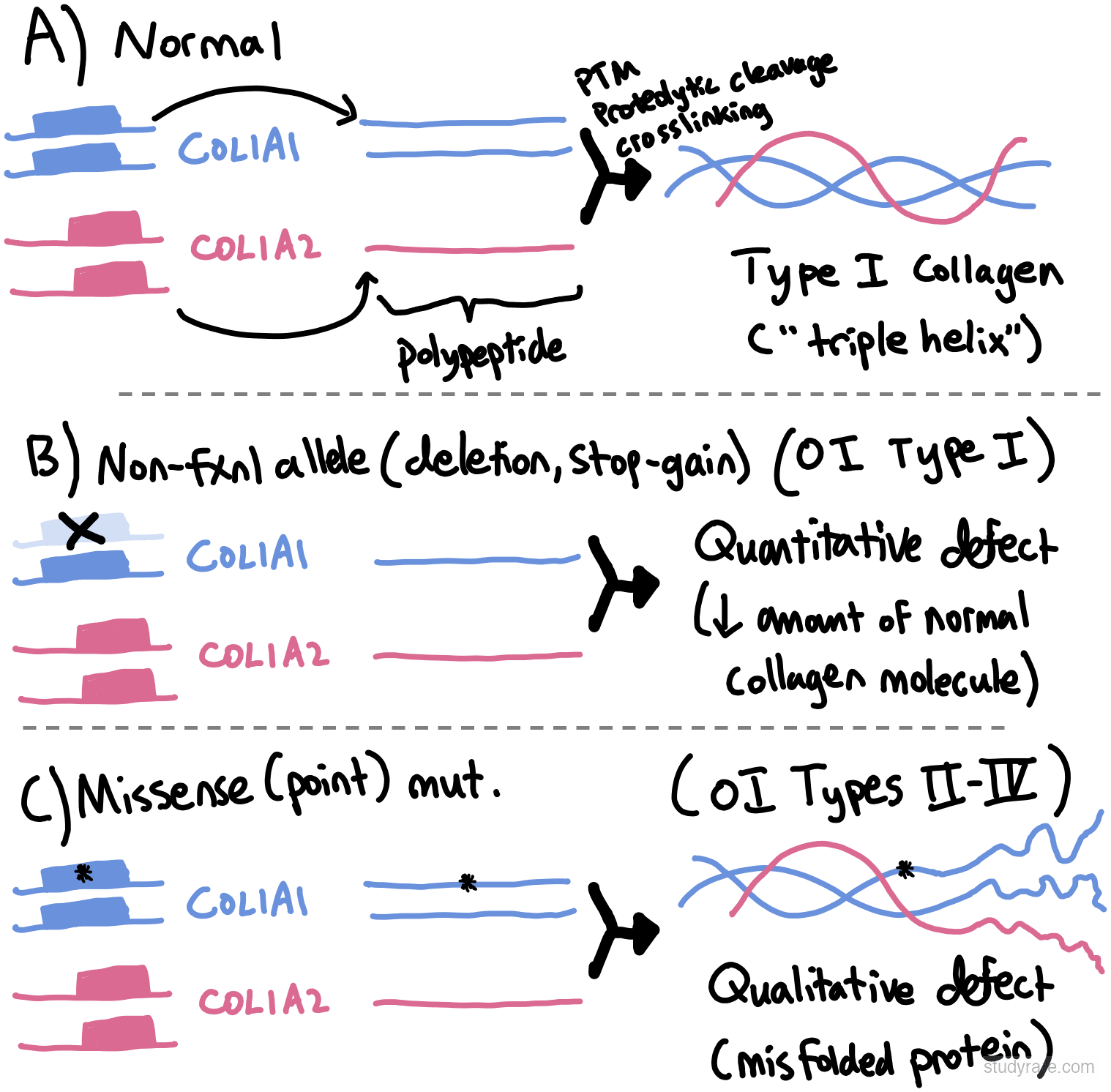
- Type I (mild): null allele, reduced collagen quantity
- Types II-IV: structural variants, abnormal collagen quality
- Rare AR forms: collagen processing genes (CRTAP, LEPRE1, PPIB)
Types:
| Type | Severity | Sclerae | Features |
|---|---|---|---|
| I | Mild | Blue | Fractures decrease after puberty, hearing loss |
| II | Lethal perinatal | Blue | Multiple fractures, crumpled bones |
| III | Severe | Variable | Progressive deformity, short stature |
| IV | Moderate | Normal/gray | Variable fractures, dental involvement |
- Fractures with minimal trauma
- Blue sclerae (type I collagen in sclera)
- Dentinogenesis imperfecta (types III, IV)
- Hearing loss (progressive, type I)
- Short stature (types II-IV)
- Wormian bones on skull X-ray
- Clinical and radiographic: recurrent low-trauma fractures, low bone density, Wormian bones, bowing deformities
- Confirmatory molecular testing of COL1A1 and COL1A2 (AR forms involve collagen-processing genes)
- Distinguishing from non-accidental trauma is critical when fractures present in infancy
- Severe forms (type II) often detected on prenatal ultrasound (multiple fractures, short/bowed long bones, decreased skull mineralization)
- Bisphosphonates, orthopedic management, physical therapy
The classic features of OI: Fragile Bone, Blue Sclerae, Hyperextensibility, Presenile Deafness.
This diagram illustrates the difference between quantitative (COL1A1 null allele, producing less but normal collagen in type I OI) and qualitative (structural variant producing abnormal collagen in types II-IV) defects in type I collagen.