PTEN hamartoma tumor syndrome (PHTS, includes Cowden)
Log in to starLast updated 4mo ago
PTEN hamartoma tumor syndrome (PHTS) is the umbrella term for the spectrum of conditions caused by germline PTEN loss-of-function variants. Historically these were named separately; they're now recognized as variable presentations of the same underlying disorder.
| Condition | Hallmark presentation | Age range |
|---|---|---|
| Cowden syndrome | Adult macrocephaly, mucocutaneous lesions, breast/thyroid/endometrial cancer | Adults |
| Bannayan-Riley-Ruvalcaba syndrome (BRRS) | Childhood macrocephaly, lipomas, pigmented penile macules, GI hamartomas | Children |
| PTEN-related Proteus / Proteus-like syndrome | Asymmetric overgrowth (rare) | Variable |
| PTEN-related autism / macrocephaly spectrum | Macrocephaly + ASD without prominent tumor features | Children |
All carry the same cancer predisposition; clinical presentation depends on age, modifiers, and chance.
A 42-year-old woman with macrocephaly (head circumference >97th percentile) presents with multiple facial trichilemmomas and oral papillomas. Mammography shows breast cancer. She has a history of follicular thyroid cancer at 35 and a cerebellar mass on brain MRI (Lhermitte-Duclos disease).
AD; PTEN (phosphatase and tensin homolog) tumor suppressor on 10q23. Loss-of-function via:
- Sequence variants (~80%): nonsense, frameshift, missense, splice
- Whole-gene deletions: detected by MLPA/CMA
- Promoter variants: rare, downregulate expression
About 25% of PTEN mutations are de novo. Penetrance is age-dependent and very high by adulthood: lifetime cancer risk ≥85% for any PHTS-spectrum cancer.
Cancer risks (lifetime)
| Cancer | Risk | Surveillance |
|---|---|---|
| Breast (female) | ~85% | Annual MRI + mammogram from age 30 |
| Thyroid (follicular > papillary) | ~35% | Annual neck US from age 7 |
| Endometrial | ~28% | Discuss endometrial sampling, hysterectomy after childbearing |
| Renal cell carcinoma | ~34% | Renal US/MRI biennially from age 40 |
| Colorectal | ~9% | Colonoscopy from age 40 |
| Melanoma | ~5% | Annual skin exam |
Non-cancer features
- Macrocephaly: a defining feature, present in the large majority (~80–90% of Cowden syndrome)
- Mucocutaneous lesions (Cowden):
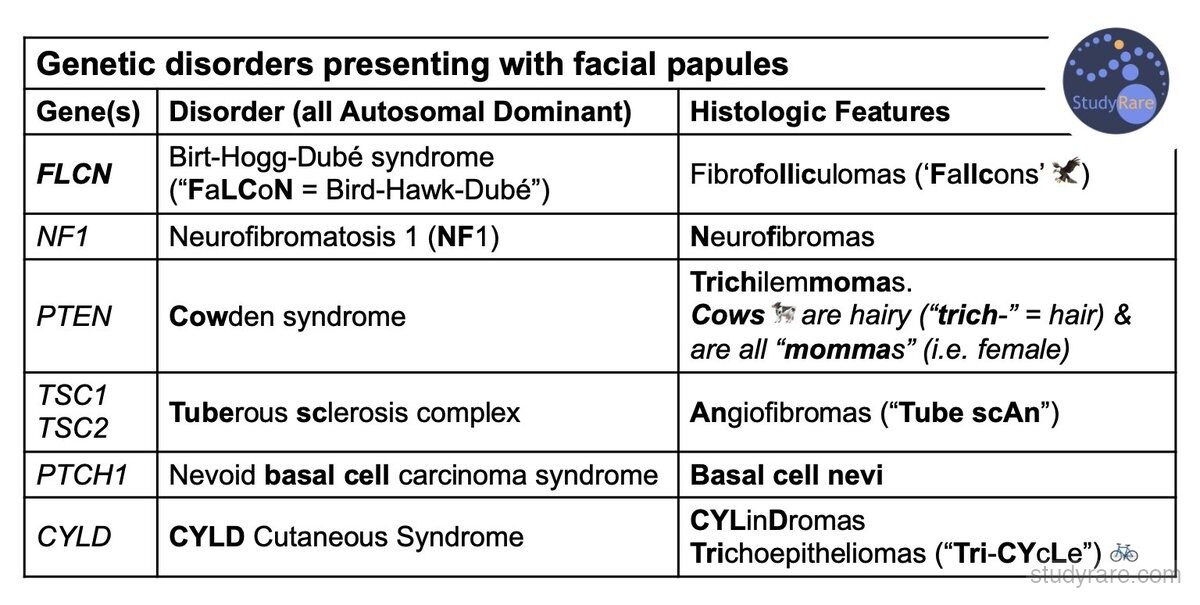
- Trichilemmomas (facial, around hair follicles)
- Oral papillomas / cobblestone tongue
- Acral keratoses (palms, soles)
- Lhermitte-Duclos disease: dysplastic cerebellar gangliocytoma; characteristic "tiger-stripe" MRI
- Lipomas: multiple, often subcutaneous (BRRS feature)
- Pigmented penile macules in males (BRRS)
- GI hamartomatous polyps: rarely transform but can bleed
- Autism / developmental delay in a subset; macrocephaly + ASD warrants PTEN testing
NCCN clinical criteria for PTEN testing:
- Adult-onset Lhermitte-Duclos disease, OR
- Macrocephaly + autism, OR
- ≥3 major criteria (breast, thyroid, endometrial, mucocutaneous, GI), OR
- 2 major + 3 minor
Confirmation: PTEN sequencing + deletion/duplication analysis. Negative test in clinically affected patient does not exclude PHTS; consider promoter analysis or another diagnosis.
- Hereditary breast and ovarian cancer (HBOC, BRCA1/2): breast/ovarian cancer, no macrocephaly or mucocutaneous lesions
- Birt-Hogg-Dubé syndrome: fibrofolliculomas + renal cancer + pneumothorax; FLCN
- Peutz-Jeghers syndrome: mucocutaneous pigmentation + GI polyps; STK11
- Familial adenomatous polyposis: colonic polyposis dominant; APC
- Tuberous sclerosis: facial angiofibromas + brain hamartomas + epilepsy; TSC1/2
- Surveillance per NCCN PHTS guidelines (table above)
- Risk-reducing mastectomy and hysterectomy discussed individually
- Avoid unnecessary radiation exposure
- Multidisciplinary care: oncology, endocrinology, dermatology, gynecology, genetic counseling
- Family cascade testing; predictive testing in adults; pediatric testing for surveillance reasons (thyroid US starts at age 7)
"BRETT the Cow sticks her big head through the PTEN (Pen)": Breast, Renal, Endometrial, Thyroid (follicular), Trichilemmomas + macrocephaly. Cowden has female-predominant cancers (breast, endometrial).
"I BET Hairy Cows have big heads": Intestinal (colorectal), Breast, Endometrial, Thyroid, Hairy = trichilemmomas, Cows = Cowden, big heads = macrocephaly.
Cows live in a PtEN (pen): the gene's name doubles as the mnemonic for the syndrome.
This table compares six genetic disorders that present with facial papules, linking each gene to its characteristic histologic findings and memory device.