
Cancer Predisposition Syndromes
Overview
Hereditary cancer syndromes represent ~5-10% of all cancers. Key concepts include tumor suppressor genes (two-hit hypothesis), DNA repair pathways, and the importance of early detection through surveillance protocols.
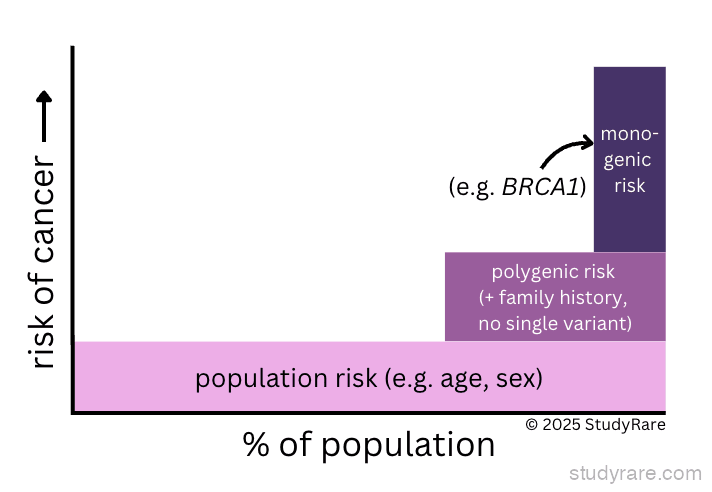
Cancer risk exists on a spectrum from population-level risk (driven by age and sex) to polygenic risk (family history, common variants) to monogenic risk (single high-penetrance genes like BRCA1). Understanding where a patient falls on this spectrum guides testing and management decisions.
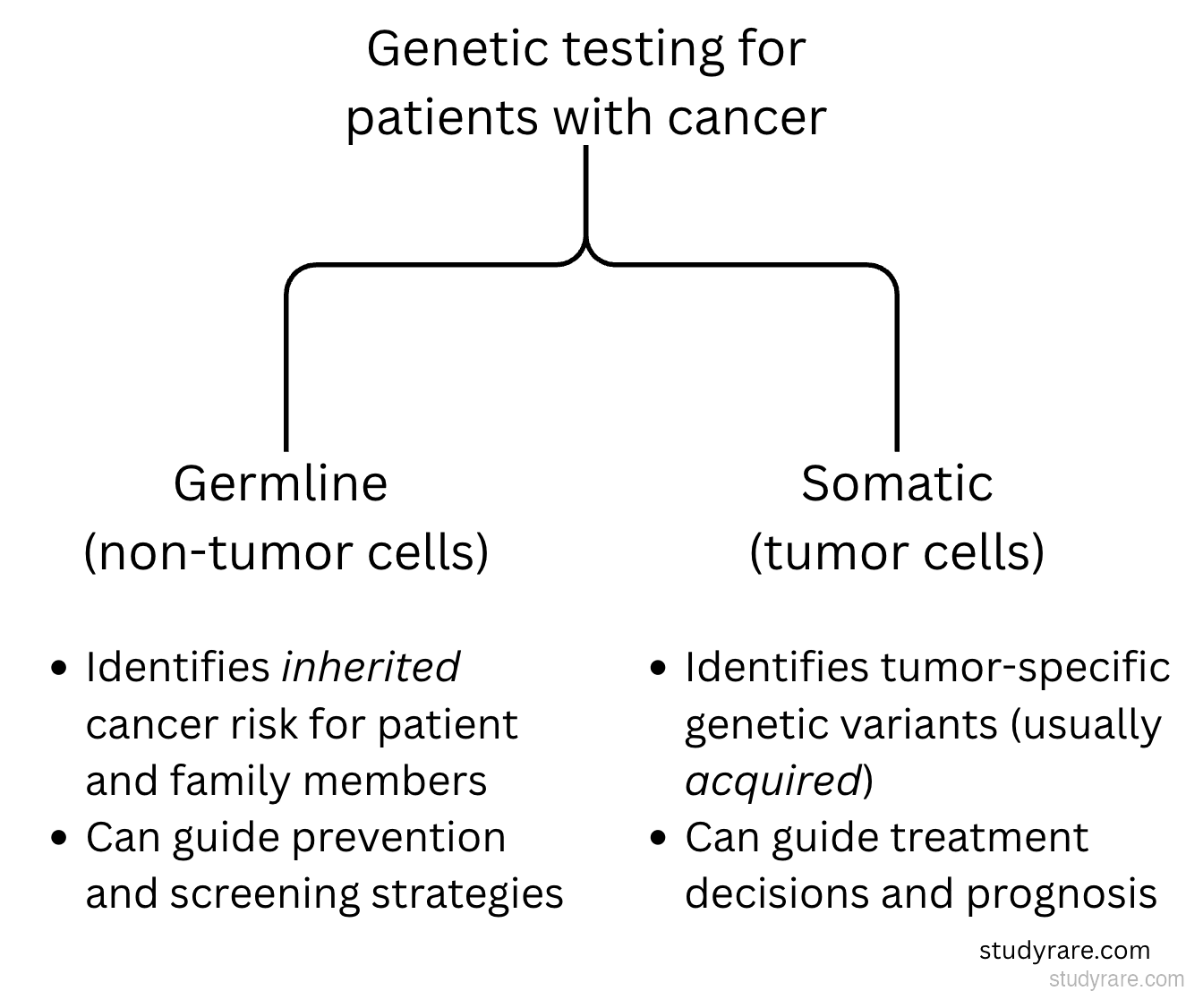
Genetic testing in oncology falls into two categories: germline testing (blood/saliva) identifies inherited cancer risk for the patient and their family, while somatic testing (tumor tissue) identifies acquired variants that may guide treatment. Both may be relevant for a single patient.
Breast and ovarian cancer
BRCA1/2 are the most important genes here. Key distinctions: BRCA1 has higher ovarian cancer risk and triple-negative breast cancers; BRCA2 has higher male breast cancer and prostate cancer risk. Both have Ashkenazi Jewish founder variants. PARP inhibitors are treatment options. CHEK2 is a moderate-penetrance gene, with lower risk than BRCA, so risk-reducing mastectomy is generally not recommended.
Colorectal cancer
The key distinction is between polyposis (FAP and MUTYH, with adenomatous polyps) and non-polyposis (Lynch, with mismatch repair deficiency and MSI-high tumors). FAP has 100% CRC risk without colectomy. Lynch syndrome (MMR genes) also causes endometrial and ovarian cancers. Peutz-Jeghers (lip pigmentation, hamartomas) has broad cancer risks. MUTYH is the only AR polyposis syndrome, requiring biallelic variants.
Gastric cancer
Hereditary diffuse gastric cancer (CDH1) has such high penetrance (70-80%) that prophylactic gastrectomy is recommended. It also causes lobular breast cancer in women. GAPPS is a distinct APC-related syndrome affecting only the stomach (no colonic polyps), an exception to typical FAP.
Endocrine tumor syndromes
MEN syndromes affect multiple endocrine organs. MEN1 (menin) = 3 Ps (Parathyroid, Pituitary, Pancreatic NETs). MEN2 (RET, gain-of-function) = Medullary thyroid cancer + Pheochromocytoma ± Parathyroid (MEN2A) or Mucosal neuromas (MEN2B). Prophylactic thyroidectomy timing depends on RET variant. SDH-related paraganglioma syndromes have parent-of-origin effects (SDHD: paternal transmission only causes disease).
DNA repair disorders
DNA repair defects cause genomic instability and broad cancer predisposition. Li-Fraumeni (TP53, "guardian of the genome") has >90% lifetime cancer risk, classically the SBLA tumors (Sarcoma, Breast, Leukemia, Adrenocortical carcinoma). Avoid radiation when possible. Xeroderma pigmentosum (nucleotide excision repair) has 1000-fold increased skin cancer risk, so extreme UV protection is essential. Bloom and Werner syndromes are progeria-like with cancer risk.
Other cancer predisposition syndromes
This section covers syndromes that don't fit the above categories. VHL (hypoxia sensing pathway) causes hemangioblastomas + clear cell RCC + pheochromocytoma. The renal cancer syndromes map to distinct histologies: VHL = clear cell, HLRCC = aggressive papillary (no nephron-sparing!), BHD = chromophobe + pneumothorax. Gorlin (PTCH1, Hedgehog pathway) causes multiple BCCs and medulloblastoma; avoid radiation.
Summary Table
| Syndrome | Gene | Inheritance | Key Cancers |
|---|---|---|---|
| HBOC | BRCA1/2 | AD | Breast, ovarian, prostate, pancreatic |
| CHEK2 | CHEK2 | AD | Breast (moderate penetrance), often HR+ |
| PALB2 | PALB2 | AD | Breast (high), pancreatic, ovarian |
| Lynch | MLH1, MSH2, MSH6, PMS2 | AD | Colorectal, endometrial, ovarian |
| FAP | APC | AD | Colorectal (100%), desmoids |
| MAP | MUTYH | AR | Colorectal |
| Peutz-Jeghers | STK11 | AD | GI, breast, pancreatic, ovarian |
| Juvenile polyposis | SMAD4, BMPR1A | AD | Colorectal, gastric; SMAD4 + HHT |
| Cowden / PHTS | PTEN | AD | Breast, thyroid, endometrial |
| HDGC | CDH1 | AD | Diffuse gastric, lobular breast |
| GAPPS | APC promoter 1B | AD | Gastric (fundic polyps), no colon |
| MEN1 | MEN1 | AD | Parathyroid, pituitary, pancreatic NET |
| MEN2 | RET | AD | Medullary thyroid, pheochromocytoma |
| HPGL/PCC | SDHx | AD | Paraganglioma, pheochromocytoma |
| Li-Fraumeni | TP53 | AD | Sarcoma, breast, brain, adrenocortical |
| CMMRD | biallelic MMR | AR | Childhood brain/heme/GI; café-au-lait |
| Bloom | BLM | AR | Leukemia, lymphoma, solid tumors |
| Werner | WRN | AR | Sarcomas, melanoma, thyroid |
| Xeroderma pigmentosum | XP genes | AR | BCC, SCC, melanoma (1000x risk) |
| FAMMM | CDKN2A | AD | Melanoma, pancreatic cancer |
| VHL | VHL | AD | RCC, hemangioblastoma, pheochromocytoma |
| HLRCC | FH | AD | Type 2 papillary RCC, cutaneous/uterine leiomyomas |
| Hereditary papillary RCC | MET | AD | Type 1 papillary RCC, bilateral/multifocal |
| BHD | FLCN | AD | RCC (chromophobe), pneumothorax |
| Gorlin | PTCH1 | AD | BCC, medulloblastoma |
Key Genetic Counseling Points for Cancer Syndromes
- Risk assessment tools: BRCAPRO, Tyrer-Cuzick, MMRpro, etc.
- Testing strategy: Start with affected individual when possible
- Variant interpretation: VUS management and reclassification
- Cascade testing: Identify at-risk family members
- Psychosocial considerations: Survivor guilt, insurance/discrimination (GINA)
- Reproductive options: PGT-M, prenatal diagnosis
- Surveillance vs. risk reduction: Shared decision-making