Xeroderma pigmentosum
Log in to starLast updated Nov 4, 2026
A child develops severe sunburns after minimal sun exposure and has freckling in sun-exposed areas by age 2. By age 10, he develops multiple skin cancers.
AR; nucleotide excision repair (NER) genes, or POLH (DNA polymerase eta) in the XP variant; loss of function
- Complementation groups XP-A to XP-G and XP-V (POLH)
- XPA (30%), XPC (27%), and POLH (23.5%) account for most cases; ERCC2 (XP-D) for 15%
UV light joins adjacent pyrimidines into cyclobutane dimers and other photoproducts that distort DNA. Nucleotide excision repair removes them. The DDB2 and XPC proteins recognize damage across the genome, while stalled RNA polymerase and the Cockayne syndrome proteins mark damage in transcribed genes. XPA then works with replication protein A and TFIIH; the TFIIH helicases XPB and XPD unwind the DNA; and XPF-ERCC1 and XPG cut on either side, releasing about 30 nucleotides that are resynthesized from the intact strand. The XP variant form is different: excision repair is normal, but without polymerase eta, which replicates across UV damage, the work falls to error-prone polymerases.
XP is biallelic loss of function in any of these proteins, so UV damage in sun-exposed skin and eyes is left unrepaired, and replication errors and tumors follow. The gene involved predicts the nervous system, which is affected in about 25% overall:
- XPA: always with neurologic abnormalities, mild or severe.
- XPC, POLH, DDB2: no neurologic abnormalities.
- ERCC2 (XP-D): none, mild, or severe; ERCC2 variants also cause trichothiodystrophy and the XP/Cockayne syndrome complex.
Neurodegeneration shortens life: median age at death 29 years with it, 37 without.
- Extreme sun sensitivity (severe burns with minimal exposure)
- Freckling in sun-exposed areas (early childhood)
- Multiple skin cancers (BCC, SCC, melanoma) - 1000-fold increased risk
- Ocular abnormalities (photophobia, keratitis, tumors)
- Progressive neurological degeneration (~25%, especially XPA)
- Median age of first skin cancer: 8-9 years
- Clinical suspicion from extreme photosensitivity (severe sunburn after minimal exposure), early sun-exposed freckling, and very early-onset skin cancers
- Functional/laboratory confirmation: cultured fibroblasts show reduced unscheduled DNA synthesis and impaired post-UV survival, reflecting defective nucleotide excision repair
- Confirm and subtype with germline testing across the complementation groups (XPA-XPG and POLH/XPV); XPA (30%) and XPC (27%) are most common, and XPA variants carry the highest neurodegeneration risk
- Strict UV protection (sunscreen, protective clothing, UV-blocking windows)
- Regular dermatologic surveillance (every 3-6 months)
- Early excision of skin cancers
- Neurological monitoring
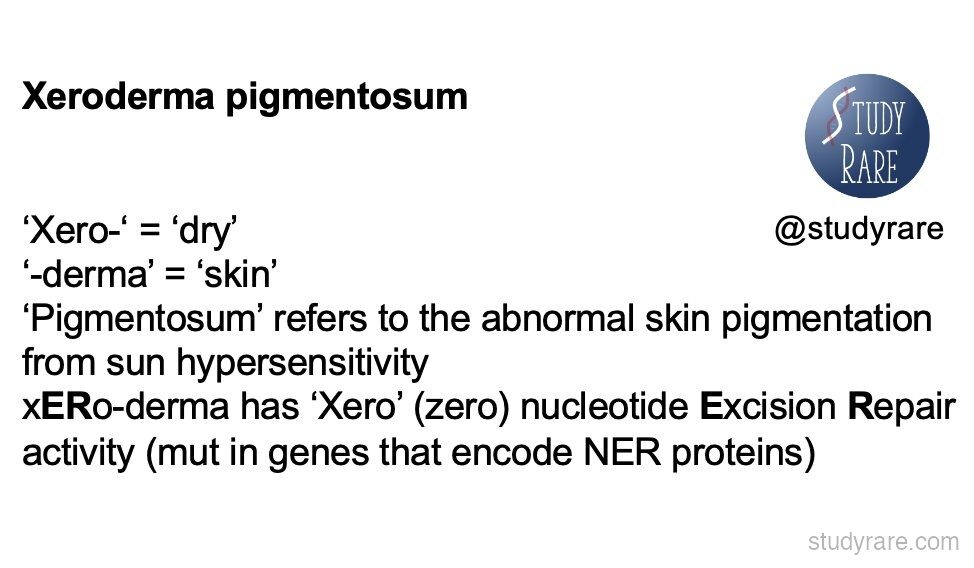
xERo-derma has "Xero" (zero) Excision Repair activity: XP = nucleotide eXcision repair defect. "Xero" = dry, "derma" = skin, "pigmentosum" = abnormal skin pigmentation from sun sensitivity.
"NER in XERoderm" (N and X both have 4 "points"): XP involves nucleotide excision repair (NER). Cannot repair T-T dimers ("XeroDimer") caused by UV damage. UV is close to X in the alphabet.
XP for "Xcision" repair: Three disorders involve NER: Xeroderma pigmentosum, Cockayne syndrome, and Trichothiodystrophy. For "TTD", turn the "t" 45 degrees clockwise and you get another "X" for "Xcision".
This overview breaks down the disease name: "Xero" = dry, "derma" = skin, "pigmentosum" = abnormal pigmentation from sun hypersensitivity, with "xERo" encoding zero nucleotide Excision Repair (NER) activity.