Simpson-Golabi-Behmel syndrome
Log in to starLast updated 4mo ago
Log in to add personal notes on this page.
A macrosomic male newborn has coarse facial features, a large tongue, and supernumerary nipples. He has developmental delay and renal anomalies.
XLR; GPC3 (glypican-3)
- Overgrowth (pre- and postnatal)
- Coarse facial features, macroglossia
- Supernumerary nipples
- Congenital anomalies (heart, kidney)
- Intellectual disability (variable)
- Embryonal tumor risk (Wilms tumor)
- Clinical recognition of pre- and postnatal overgrowth with coarse facies, macroglossia, and supernumerary nipples in a male
- Confirm with GPC3 sequencing and deletion/duplication analysis (X-linked); GPC4 contiguous deletions in some
- Baseline cardiac and renal imaging for congenital anomalies
- Tumor surveillance for embryonal tumors as in Beckwith-Wiedemann: abdominal ultrasound every ~3 months through early childhood, with serum AFP per protocol
- Management of congenital anomalies (cardiac, renal) and macroglossia (airway, feeding, dental)
- Developmental support and monitoring for intellectual disability
- Genetic counseling: X-linked; carrier females may have mild manifestations and are at risk of transmitting
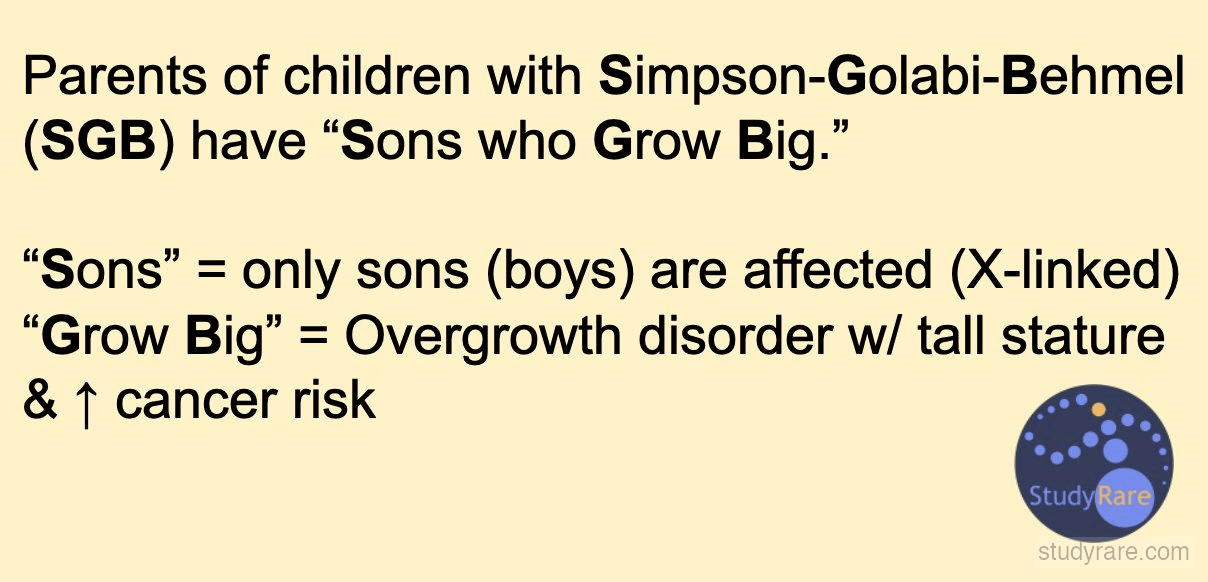
"Sons who Grow Big": Parents of children with SGB have "Sons who Grow Big": Sons = only boys are affected (X-linked), Grow Big = overgrowth with increased cancer risk. Simpson-"Growlabi" makes you "grow" in every way: increased in size (large head, body, tongue, mouth) and in number (extra fingers, kidneys, nipples). Golabi = Glypican-3 (GPC3). SGB is the Sex-linked overgrowth syndrome (all others are AD).