
Nail-patella syndrome (Fong disease)
Log in to starLast updated 1mo ago
A 9-year-old is referred for recurrent knee dislocations. The thumbnails are small and split with triangular lunulae, the fifth fingernails look normal, and the elbows do not fully extend. A pelvic radiograph ordered for hip pain shows bilateral conical bony projections off the posterior iliac wings. Urinalysis shows 2+ protein.
- Autosomal dominant, LMX1B (9q33.3), a LIM-homeodomain transcription factor
- Loss-of-function through haploinsufficiency; sequencing plus deletion analysis identifies a variant in roughly 85 to 95% of people meeting clinical criteria
- About 20% of cases are de novo
- Penetrance is essentially complete, but expressivity varies widely within a single family, so severity in a parent does not predict severity in a child
- Also called hereditary onycho-osteodysplasia (HOOD) and Fong disease, the latter after the iliac horns
The classic tetrad is nails, patellae, elbows, and iliac horns, in that order of frequency.
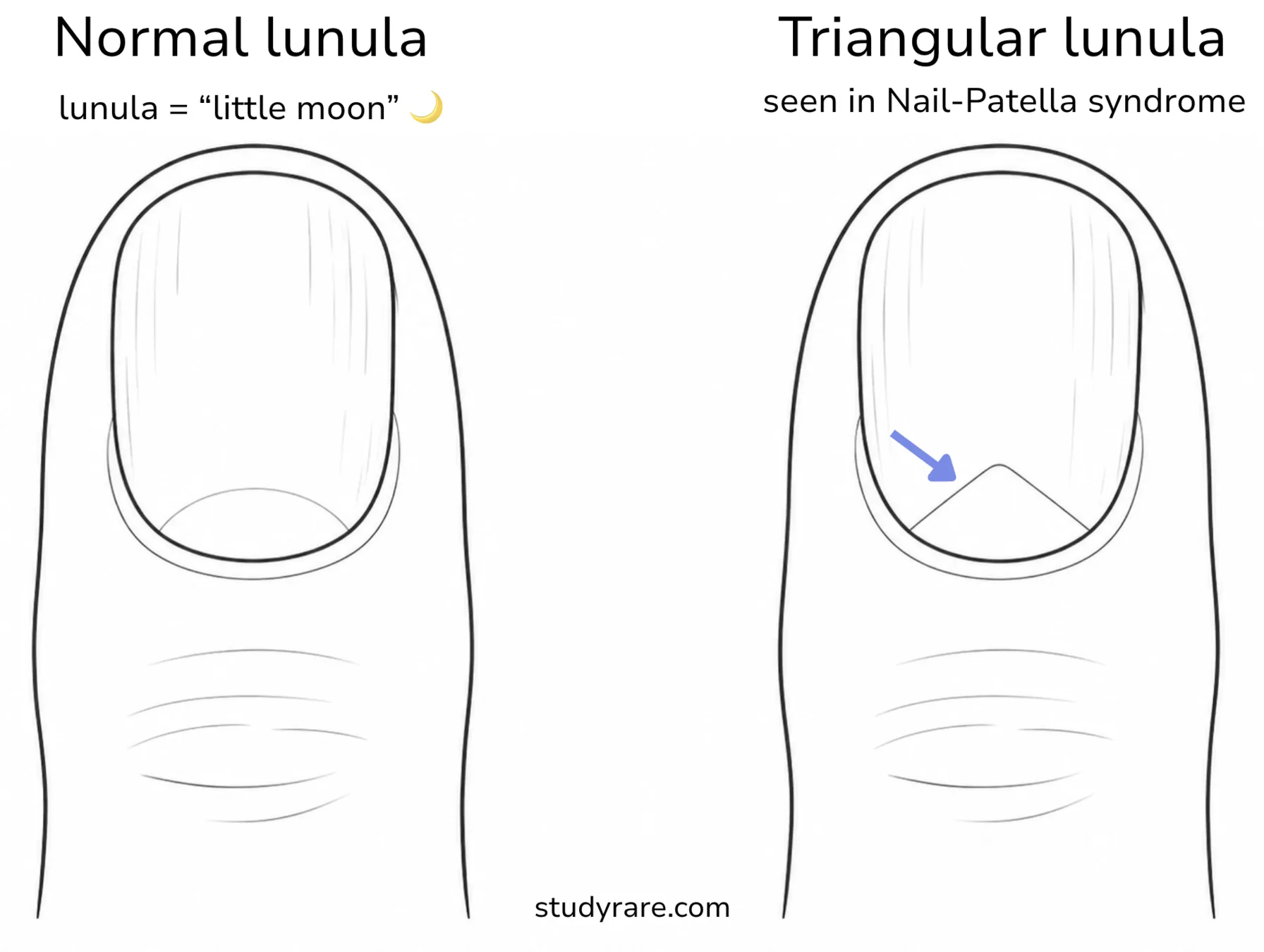
- Nail dysplasia (~98%): absent or hypoplastic nails, longitudinal ridging, splitting, koilonychia. Severity follows a radial-to-ulnar gradient, worst on the thumbs and decreasing toward the fifth digit. Triangular lunulae are effectively pathognomonic
- Patellar hypoplasia or aplasia (~90%): small, irregular, or absent patellae with recurrent lateral subluxation and dislocation, knee pain, and early degenerative change. The lateral femoral condyle is often hypoplastic
- Elbow dysplasia (~90%): limited extension, pronation, and supination; cubitus valgus; antecubital pterygia; radial head hypoplasia or posterior dislocation
- Iliac horns (~70%): bilateral conical exostoses projecting posteriorly from the iliac wings. Asymptomatic and visible only on imaging, but pathognomonic when present
- Nephropathy (30 to 50%): proteinuria, sometimes with microscopic hematuria, presenting from childhood through adulthood. Roughly 5 to 15% progress to end-stage kidney disease. This is the feature that determines long-term outcome
- Primary open-angle glaucoma and ocular hypertension: increased risk, with onset earlier than in the general population
- Less consistent: sensorineural hearing loss, constipation and irritable bowel symptoms, thin upper lip
- The clinical tetrad is usually sufficient; a pelvic radiograph for iliac horns is the cheapest confirmatory image and is often the finding that settles an uncertain case
- Molecular confirmation by LMX1B sequencing with deletion/duplication analysis
- If a kidney biopsy is done, electron microscopy shows irregular thickening of the glomerular basement membrane with electron-lucent "moth-eaten" areas containing fibrillar type III collagen. This is distinct from the lamellated, basket-weave splitting of Alport syndrome
Genotype-phenotype note: specific missense variants in the LMX1B homeodomain, most notably at the p.Arg246 residue, cause an isolated nephropathy with no nail, patellar, elbow, or iliac findings. A family with dominant proteinuric kidney disease and a normal skeletal exam can still be LMX1B-related, so the absence of the tetrad does not exclude the gene.
- Clouston syndrome and hypohidrotic ectodermal dysplasia: nail dystrophy with hair and sweat gland involvement, no patellar or iliac findings
- Alport syndrome: hereditary nephropathy with hearing loss and lenticonus, but normal nails and patellae and a different basement membrane ultrastructure
- Small patella syndrome (TBX4): patellar hypoplasia with pelvic anomalies but normal nails and no nephropathy. The cleanest discriminator is the nails
- Genitopatellar syndrome (KAT6B): absent patellae with intellectual disability, renal cysts, and genital anomalies
- Annual urine protein-to-creatinine ratio and blood pressure from the time of diagnosis, lifelong, including in people with mild skeletal findings. Refer to nephrology once proteinuria appears
- ACE inhibitor or angiotensin receptor blocker for proteinuria; kidney transplant outcomes are good and the disease does not recur in the graft
- Annual eye examination with intraocular pressure from adolescence
- Orthopedic and physical therapy management of patellar instability; bracing and quadriceps strengthening before considering realignment surgery
- Reproductive counseling: 50% recurrence for each pregnancy, with prenatal or preimplantation testing available once the familial variant is known
NAIL carries the whole condition:
- Nephropathy (the part that determines outcome)
- Absent or hypoplastic patella
- Iliac horns
- LMX1B
For the nail gradient, the thumb takes the worst of it and severity fades toward the little finger.